Suin-Bundang Line · Seoul
The Bundang Line (opened 1994) and the Suin Line began through-running as a single line on September 12, 2020, once the Suin Line's Suwon section was fully completed. A December 2018 extension stretched it to Cheongnyangni; it now runs from there through Bundang and Suwon to Incheon, one of the longest lines in the capital region.
At a glance
- Stations
- 63
- From
- Cheongnyangni
- To
- Incheon
- Interchanges
- 21
- Difficulty
- Lv 6 of 7
- Keystrokes
- ~422
Suin-Bundang Line runs from Cheongnyangni to Incheon, 63 stops in the order you type them. Measured in straight lines between the station coordinates, the run is about 102.0 km, an average of 1.6 km between stops. The longest gap is Omokcheon to Eocheon, about 5.0 km, and the shortest is Dogok to Guryong, about 570 m. The real track is a little longer than these straight lines.
Typing every station name once takes about 422 keystrokes, which is difficulty level 6 of 7 among Seoul's lines. The level only compares lines within one city, so use the keystroke count to compare across cities. At the Cheongnyangni end the game shows Kyung Hee University Main Building, and at the Incheon end, Incheon Chinatown.
You can change to 10 other lines: Line 1, Gyeongui-Jungang Line, Line 2, Line 5, Line 7, Line 9, Line 3, Line 8, Sinbundang Line, Line 4. The busiest interchange is Wangsimni, where 3 other lines meet this one. The interchange stations are Cheongnyangni, Wangsimni, Gangnam-gu Office, Seonjeongneung, Seolleung, Dogok, Suseo, Bokjeong, and 13 more.
Read the full guide: Suin-Bundang Line stations: Cheongnyangni through Gangnam and Suwon to Incheon.
Along the way
The game shows a nearby place at each station. Some of the ones on Suin-Bundang Line:
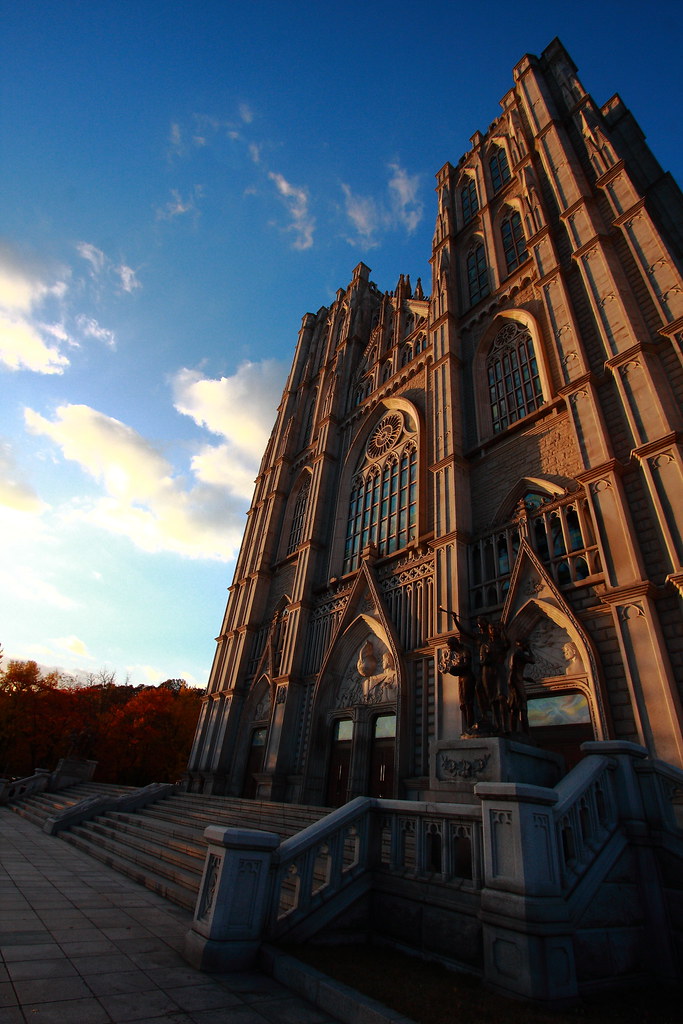
Kyung Hee University Main Building at Cheongnyangni. Completed in 1956 and now a registered national heritage building, this neoclassical hall blends Western academic architecture with Korean motifs like the taegeuk symbol and mugunghwa flower carvings.Photo: Zyan · CC BY 2.0 
Dosan Park at Gangnam-gu Office. A park named after the pen name of independence activist Ahn Chang-ho, whose grave and memorial hall stand on its grounds.Photo: Republic of Korea · CC BY 2.0 
Guryong Village at Guryong. A settlement at the foot of Guryongsan Mountain, formed in the 1980s-90s by residents displaced during Gangnam's rapid urban development; it remains one of Seoul's best-known informal shanty settlements, and the station takes its name from both the village and the mountain.Photo: Abasaa · Public domain 
Gachon University Global Campus at Gachon University. The Seongnam campus of Gachon University, formed in 2012 when Kyungwon University (founded 1988) merged with Gachon University of Medicine and Science; the campus connects directly to the station.Photo: Mtomg · CC BY-SA 4.0 
AK Plaza Bundang at Seohyeon. A large department store building directly connected to Seohyeon Station. It opened in 1997 as Samsung Plaza and has operated under the AK Plaza brand since 2007, remaining one of Bundang's signature shopping landmarks since the new town's early days.Photo: 분당선M · CC BY 3.0 
Dongmakcheon Walking Path at Ori. A walking path that follows the small Dongmakcheon stream near Ori Station, shared with a bike lane and popular with locals for daily walks and exercise.Photo: Bykim2012 · CC0 
Nam June Paik Art Center at Giheung. A museum dedicated to researching, collecting and exhibiting the work of video art pioneer Nam June Paik (1932-2006), opened in 2008 under the Gyeonggi Cultural Foundation. The wooded grounds around the building hold Paik's experimental outdoor sculptures, including pieces built from old cathode-ray-tube televisions, making a stroll through the site part of the exhibit.Photo: PunkToad · CC BY 2.0 
Gyeonggi Arts Center at Suwon City Hall. Gyeonggi Province's flagship performing-arts complex, opened in 1988 with a large theater, a small theater and a traditional music hall that together host everything from opera and classical concerts to local festivals. Also known by its formal name Gyeonggi Culture and Arts Center, it is within walking distance of Suwon City Hall Station.Photo: Nt · CC BY-SA 4.0 
Tomb of General Choi Jeong-geol at Sari. This is the tomb of General Choi Jeong-geol, a Joseon military officer who died charging into enemy ranks during the 1636 Manchu invasion. Located on a hillside in Sa-dong, Ansan, it was designated Ansan City Local Heritage No. 8 in 1991 and lies within walking distance of Sari Station.Photo: Piotrus · CC BY-SA 3.0 
Ansan Wa Stadium at Choji. A multi-purpose stadium near Choji Station, completed in 2006 and used for football matches at the 2014 Incheon Asian Games; it now serves as the home ground of K League 2 club Ansan Greeners FC.Photo: WAKA77 · Public Domain 
Sorae Port Tidal Flat at Dalwol. Sorae Port, about 2 km in a straight line from Dalwol Station. A bridge and the city appear beyond the exposed tidal flat.Photo: Jjw · CC BY-SA 4.0 
Neungheodae Site at Songdo. A historic site said to mark the old harbor from which the Baekje kingdom once dispatched envoys to southern China, now marked by a small octagonal pavilion called Neungheodae. Designated an Incheon monument in 1990, it stands at the end of a pine-forested walking path on a hill in Ongnyeon-dong.Photo: Jjw · CC BY-SA 4.0
All 63 stations
Along the line, from Cheongnyangni to Incheon:
- 124Cheongnyangni1K
- 208Wangsimni25K
- K211Seoul Forest
- K212Apgujeong Rodeo
- 730Gangnam-gu Office7
- K214Seonjeongneung9
- 220Seolleung2
- K216Hanti
- 344Dogok3
- K218Guryong
- K219Gaepo-dong
- K220Daemosan Entrance
- 349Suseo3
- K222Bokjeong8
- K223Gachon University
- K224Taepyeong
- K225Moran8
- K226Yatap
- K227Imae
- K228Seohyeon
- K229Sunae
- D12JeongjaD
- D13MigeumD
- K232Ori
- K233Jukjeon
- K234Bojeong
- K235Guseong
- K236Singal
- K237Giheung
- K238Sanggal
- K239Cheongmyeong
- K240Yeongtong
- K241Mangpo
- K242Maetan Gwonseon
- K243Suwon City Hall
- K244Maegyo
- K245Suwon1
- K246Gosaek
- K247Omokcheon
- K248Eocheon
- K249Yamok
- K250Sari
- 449Handaeap4
- 450Jungang4
- 451Gojan4
- 452Choji4
- 453Ansan4
- 454Singiloncheon4
- 455Jeongwang4
- 456Oido4
- K259Dalwol
- K260Wolgot
- K261Soraepogu
- K262Incheon Nonhyeon
- K263Hogupo
- K264Namdong Industrial Park
- K265Woninjae
- K266Yeonsu
- K267Songdo
- K269Inha University
- K270Sungeui
- K271Sinpo
- 161Incheon1