Line 1 · Seoul
Korea's first subway line, opened August 15, 1974 as a short 9-station stretch between Seoul Station and Cheongnyangni. Through-running with Korail lines later stretched it from Soyosan in the north down to Incheon, and on December 16, 2023 it was extended north from Soyosan through Cheongsan and Jeongok to Yeoncheon. It forms the capital region's oldest urban corridor.
At a glance
- Stations
- 65
- From
- Yeoncheon
- To
- Incheon
- Interchanges
- 18
- Difficulty
- Lv 6 of 7
- Keystrokes
- ~421
Line 1 runs from Yeoncheon to Incheon, 65 stops in the order you type them. Branches of the real line are drawn on the game map but are not part of the typing route. Measured in straight lines between the station coordinates, the run is about 104.2 km, an average of 1.6 km between stops. The longest gap is Yeoncheon to Jeongok, about 8.5 km, and the shortest is Dongmyo to Dongdaemun, about 560 m. The real track is a little longer than these straight lines.
Typing every station name once takes about 421 keystrokes, which is difficulty level 6 of 7 among Seoul's lines. The level only compares lines within one city, so use the keystroke count to compare across cities. At the Yeoncheon end the game shows Chatan-ri Dolmens, Yeoncheon, and at the Incheon end, Incheon Chinatown.
You can change to 12 other lines: Line 7, Line 4, Line 6, Gyeongui-Jungang Line, Suin-Bundang Line, Line 2, Ui-Sinseol Line, Line 3, Line 5, Airport Railroad Express, Line 9, Sillim Line. The busiest interchange is Seoul Station, where 3 other lines meet this one. The interchange stations are Dobongsan, Changdong, Seokgye, Hoegi, Cheongnyangni, Sinseol-dong, Dongmyo, Dongdaemun, and 10 more.
Read the full guide: Seoul Subway Line 1 stations: Korea's first subway, from Yeoncheon to Incheon.
Along the way
The game shows a nearby place at each station. Some of the ones on Line 1:

Chatan-ri Dolmens, Yeoncheon at Yeoncheon. The Chatan-ri dolmens, a little over 600 metres from Yeoncheon station. Flat stones lie in an open lot in the middle of the village.Photo: Aspere · CC0 
A Park in Dongducheon at Bosan. A park in Dongducheon, with a wide path running between pines and deciduous trees and people walking.Photo: Georgia National Guard · CC BY 2.0 
Hoeryongcheon Stream Cherry Blossom Path at Ganeung. The bank of the Hoeryong stream, a little over 2 km south of Ganeung Station. A cherry-blossom walking path follows the water, with an elevated light-rail viaduct passing overhead.Photo: Yann Michel Cueroni · CC BY-SA 4.0 
View of Dobong-gu and Nowon-gu from Dobongsan at Dobong. A view of Dobong-gu and Nowon-gu districts as seen from partway up Dobongsan. Dobong station sits at the main trailhead entrance to the mountain.Photo: Seongbin Im · CC BY-SA 2.0 
Kwangwoon University at Gwangwoon University. A private university founded in 1934, after which the station is named; its main gate is roughly a 10-minute walk from the station.Photo: Moriarty.L · CC BY-SA 3.0 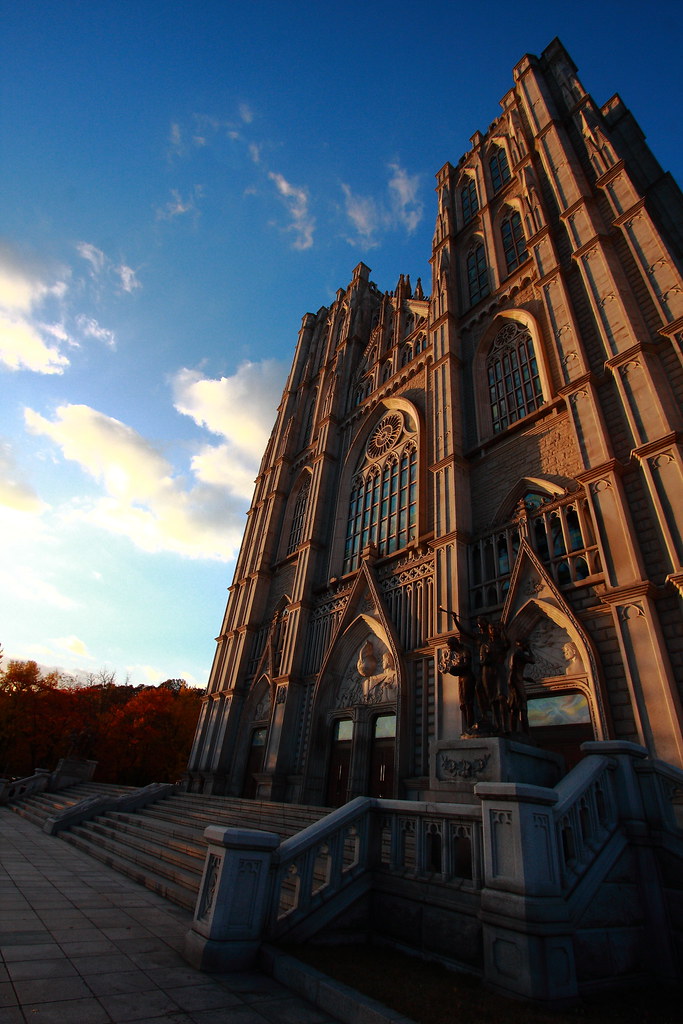
Kyung Hee University Main Building at Cheongnyangni. Completed in 1956 and now a registered national heritage building, this neoclassical hall blends Western academic architecture with Korean motifs like the taegeuk symbol and mugunghwa flower carvings.Photo: Zyan · CC BY 2.0 
Tapgol Park at Jongno 3(sam)-ga. The site where the March 1st Independence Declaration was read aloud in 1919, and Seoul's first modern park, home to the ten-story stone pagoda of the former Wongaksa temple site.Photo: Tristan Surtel · CC BY-SA 4.0 
Yongsan Electronics Market at Yongsan. Korea's largest cluster of electronics and IT retail arcades, a wholesale and retail hub for computers and gadgets that has thrived since the 1980s.Photo: Andrew Currie · CC BY 2.0 
D-Cube City at Sindorim. A mixed-use complex completed in 2011 that combines a department store, a musical theater, and office towers, linked directly to Sindorim Station by an underground passage.Photo: Brit in Seoul · CC BY-SA 4.0 
Pureun Arboretum at Yeokgok. Seoul's first public arboretum, with more than 20 themed gardens including a wildflower garden and a rose garden, plus a reservoir; located about 1.2 km from Yeokgok Station, it's also known as a popular spot for autumn foliage walks.Photo: Shinfull · CC BY-SA 4.0 
Sangdong Lake Park at Bugae. A lake park within walking distance of Bugae Station, built around a lake with a wide lawn and walking trails.Photo: travel oriented · CC BY-SA 2.0 
Juanseo-ro Street in Winter at Juan. A winter street scene along Juanseo-ro, a road running through Juan-dong where Juan Station is located.Photo: Narubaru7 · CC BY 4.0
All 65 stations
Along the line, from Yeoncheon to Incheon:
- 100-3Yeoncheon
- 100-2Jeongok
- 100-1Cheongsan
- 100Soyosan
- 101Dongducheon
- 102Bosan
- 103Dongducheon Jungang
- 104Jihaeng
- 105Deokjeong
- 106Deokgye
- 107Yangju
- 108Nogyang
- 109Ganeung
- 110Uijeongbu
- 111Hoeryong
- 112Mangwolsa
- 710Dobongsan7
- 114Dobong
- 115Banghak
- 412Changdong4
- 117Nokcheon
- 118Wolgye
- 119Gwangwoon University
- 644Seokgye6
- 121Sinimun
- 122Hankuk Univ. of Foreign Studies
- 123HoegiK
- 124CheongnyangniKK
- 125Jegidong
- 211-4Sinseol-dong2S
- 636Dongmyo6
- 421Dongdaemun4
- 129Jongno 5(o)-ga
- 329Jongno 3(sam)-ga35
- 131Jonggak
- 201City Hall2
- 426Seoul Station4KA
- 134Namyeong
- 135YongsanK
- 136Noryangjin9
- 137DaebangS
- 525Singil5
- 139Yeongdeungpo
- 234Sindorim2
- 141Guro
- 142Guil
- 143Gaebong
- 144Oryudong
- 750Onsu7
- 146Yeokgok
- 147Sosa
- 148Bucheon
- 149Jungdong
- 150Songnae
- 151Bugae
- 152Bupyeong
- 153Baegun
- 154Dongam
- 155Ganseok
- 156Juan
- 157Dohwa
- 158Jemulpo
- 159Dowon
- 160Dongincheon
- 161IncheonK