London subway lines
10 lines and 214 stations, all playable in HelloSubway.
The London Underground is the oldest underground railway in the world. The Metropolitan Railway opened on January 10, 1863, between Paddington and Farringdon. Steam locomotives pulled gas-lit wooden carriages, and about 38,000 people rode on the first day.
London's lines have names instead of numbers. The game has Bakerloo, Central, Circle, District, Hammersmith & City, Jubilee, Metropolitan, Northern, Piccadilly and Victoria, each in its Tube map color. Many of these split into branches. HelloSubway follows the main route and draws the other branches on the map without asking you to type them.
London subway map
All 10 lines in one picture. Tap a line in the key to open its guide.
- Bakerloo line
- Central line
- Circle line
- District line
- Hammersmith & City line
- Jubilee line
- Metropolitan line
- Northern line
- Piccadilly line
- Victoria line
How to ride the London subway
Tap in and out with a contactless bank card or a phone. You do not need to buy a ticket. An Oyster card costs the same per journey, so it is only worth having if you do not want to use your own card. Both are capped, so you stop paying after a daily limit, and there is a weekly one too.
Use the same card or device every time. London adds up your trips by card number, so paying with your phone one way and your card the other can mean two separate charges. Tap out at the end, or you will be charged a long fare. Fares depend on the zones you cross and the time of day. Check the Transport for London site for current prices.

An Oyster reader. Contactless bank cards and phones use the same reader. Photo: Oxyman · CC BY 2.5 
An Oyster machine, where you can buy a card and top it up. Photo: Nick Cooper at English Wikipedia. · CC BY-SA 2.5
Buying a ticket or card
You can ride with a contactless bank card or phone, so there is nothing to buy. If you want an Oyster card, buy one from a ticket machine or a ticket office, or at some shops, and top it up at the same machines. Top up before you travel if you can, since machines can have a queue at busy stations. Oyster and contactless give the same fares and caps, so choose whichever is easier.
Subway manners
On escalators, stand on the right and walk on the left. When the train arrives, stand to one side of the doors and let people off first. Mind the gap between the train and the platform. Have your card ready before you reach the gate so you do not block the people behind you. As long as the reader has turned to orange, you can tap even if the barriers have not yet opened.
From the airport to the city
Heathrow has three rail options. The Piccadilly line is the cheapest and takes close to an hour. The Elizabeth line is faster and goes on to the City and Canary Wharf. Heathrow Express reaches Paddington in about fifteen minutes and costs much more. If you are not in a hurry, take the Elizabeth line. Gatwick and Stansted have separate rail links and are not on the Tube.
Common mistakes for first-time riders
Check the destination on the front of the train. Many lines split into branches, and the next train may not go where you want. On escalators, stand on the right. Some stations that look close on the map are a long walk apart, so check the walking time first.
London in photos
Photos of London and of places you pass on its lines. Every photo is credited to its photographer under its open licence.
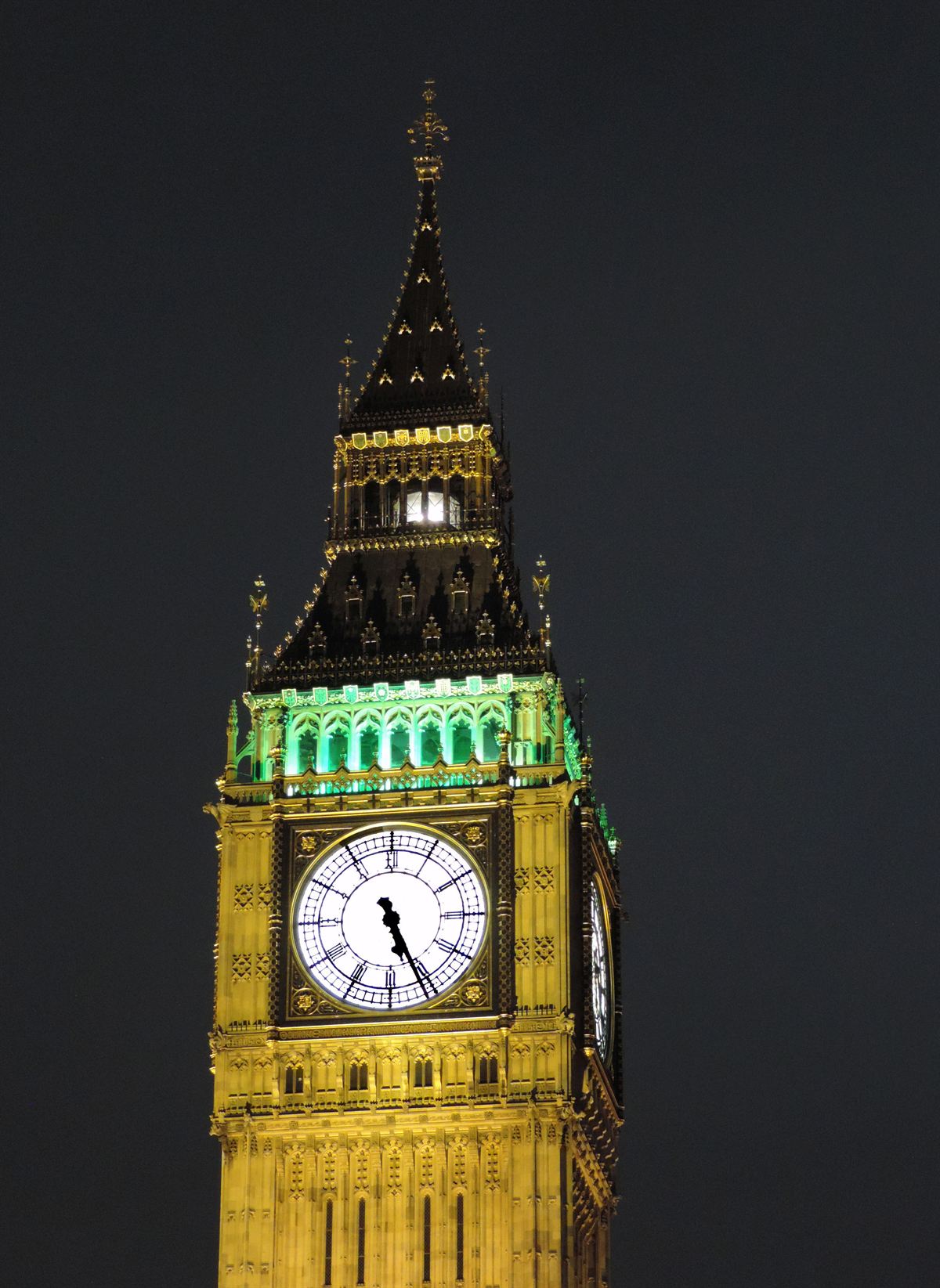
Photo: Donnchadh H · CC BY 2.0 
Photo: ThatsTheBoss · CC0 
Photo: Mike Peel (www.mikepeel.net) · CC BY-SA 4.0 
Photo: ThatsTheBoss · CC0 
Tower Bridge at Tower Hill. Opened in 1894 to ease road traffic across the Thames without blocking tall-masted ships, this bascule bridge can still raise its twin road spans to nearly vertical, now on electrically powered machinery rather than the original Victorian hydraulics. Its Gothic stone towers were designed to visually match the nearby Tower of London rather than reveal the steel frame underneath.Photo: Fuzzypiggy · CC BY-SA 3.0 
Big Ben (Elizabeth Tower) at Westminster. Completed in 1859 and renamed the Elizabeth Tower in 2012 for the Queen's Diamond Jubilee, the tower is best known by the nickname of its 13.5-tonne Great Bell, Big Ben. A five-year restoration completed in 2022 saw the clock faces repainted in their original Victorian blue and gold colour scheme.Photo: Colin · CC BY-SA 4.0 
Natural History Museum at South Kensington. Designed by Alfred Waterhouse and opened in 1881, the Natural History Museum's terracotta facade is covered in carved relief panels of animals and plants, with extinct species on the west wing and living ones on the east. A blue whale skeleton nicknamed Hope has hung in the entrance hall since 2017, replacing the museum's long-running Diplodocus cast.Photo: Daniel Lu (dllu) · CC BY-SA 4.0 
St Pancras Renaissance Hotel at King's Cross St Pancras. William Barlow's train shed opened in 1868 behind a red-brick Gothic Revival frontage designed by George Gilbert Scott, completed in 1873 as the Midland Grand Hotel. Its curved arcades of red and cream brick, patterned arches and pointed towers made it one of the most extravagant Victorian buildings in London before a long closure and eventual restoration as a hotel in 2011.Photo: Peter Shimmon · CC BY-SA 2.0 
Monument to the Great Fire of London at Monument. Designed by Christopher Wren and Robert Hooke and completed in 1677, this 61-metre Doric column stands exactly 202 feet from the Pudding Lane bakery where the Great Fire of London began in 1666, its height matching that distance. A gilded urn of flames tops the column, and 311 spiral steps lead up to a viewing platform once used by Hooke for scientific experiments.Photo: Jwslubbock · CC BY-SA 4.0 
Barbican Conservatory at Barbican. Opened in 1984 above the Barbican Theatre's fly tower, this glasshouse is the second largest conservatory in London after Kew, packed with more than 2,000 species of tropical plants alongside a small pond of koi carp and terrapins. It was built simply to hide the theatre's stage machinery, but grew into one of the estate's best-loved secret gardens.Photo: Charld99 · CC0 
Cleopatra's Needle at Embankment. An ancient Egyptian obelisk carved around 1450 BC, gifted to Britain and re-erected on the Victoria Embankment in 1878 after nearly being lost at sea during its transport.Photo: Nigel Chadwick · CC BY-SA 2.0 
The Churchill Arms at Notting Hill Gate. Renamed in tribute to Winston Churchill after the Second World War, this Kensington Church Street pub had earlier been a regular haunt of Churchill's grandparents, the Duke and Duchess of Marlborough. It is now known for the thousands of hanging baskets and trailing flowers that cover its facade each summer.Photo: Marathon · CC BY-SA 2.0
Stories about London
 HistoryWhich city built the first subway? London in 1863, and five more firstsLondon opened the world's first underground railway in 1863. Then Budapest, Boston, New York, Tokyo and Seoul, and how each first line began.
 HistoryThe Tube map is a diagram, and that is why it worksHarry Beck drew it in 1931 after losing his job. It throws away distance on purpose, and that is the whole trick.
 Photo rideThe Circle line is not a circleSince 2009 it has been a spiral, and it still passes the oldest stretch of underground railway in the world.
 HistorySame name, different stationSome stations that share a name are hundreds of meters apart. Some that look separate are one building. Sorting them out took more work than any other part of the data.
 HistoryHow we check the station data, and the mistakes we foundHelloSubway has 84 lines and about 1,800 stations in six cities. The first draft of that data was wrong in more places than we like to admit.
 HistoryHow you pay for the subway in six citiesTap a bank card in New York, London and Singapore. Buy a card first in Seoul and Tokyo. Paris is halfway through the change. A short comparison for a first visit.
 History124 years in six cities: when our first lines openedLondon 1863, Paris 1900, New York 1904, Tokyo 1927, Seoul 1974, Singapore 1987. The gaps between them are 37, 4, 23, 47 and 13 years.
 Photo rideLondon's Victoria line in sixteen photographs, from Brixton to WalthamstowSixteen stops and one photograph for each of them, on the Tube line that was new in 1968, from a market street in south London to the home of William Morris.
 HistoryGhost stations: the closed platforms between the stations you typeBetween some pairs of stations in the game there is a third one, closed for decades. Churchill's war cabinet used one in London. Four in Paris shut in 1939. Tokyo's lasted eight months.
 TypingMetro station quiz: 20 station names, six cities. Can you place them?Dover, Rome, Europe, Argentine, Stadium. Every one of these is a real metro station in the game, and most of them are not where the name suggests. Answers at the bottom.
Station exit guides
Which exit to take for the main sights, from the official tourism pages for each station.
Station names in London
Some names include an apostrophe or an ampersand, such as St. Paul's and Elephant & Castle, and they are typed the way they appear on the station roundels.
All London lines
- Bakerloo line25 stations · Lv 3/7 · ~316 keystrokes
Opened in March 1906 between Lambeth North (then Kennington Road) and Baker Street, extended to Elephant & Castle five months later. Its name is a portmanteau of its original title, the Baker Street and Waterloo Railway. The line reached Queen's Park in 1915 and Watford Junction in 1917, and also ran the Stanmore branch from 1939 until it was handed over to the newly created Jubilee line in 1979.
- Central line37 stations · Lv 4/7 · ~405 keystrokes
Descended from the Central London Railway, which opened between Shepherd's Bush and Bank on 30 July 1900 with a flat two-penny fare that earned it the nickname the 'Twopenny Tube'. The 1930s-40s New Works Programme extended it far to the west (to West Ruislip and Ealing Broadway) and east (to Epping), and folded in a former Great Eastern Railway loop (Barkingside, Fairlop, Hainault) to complete today's Hainault loop.
- Circle line35 stations · Lv 5/7 · ~443 keystrokes
Formed in 1884 when the Metropolitan and District railways completed the Inner Circle, making it the world's first circular underground line. It ran as a true loop for over a century, but a 2009 extension to Hammersmith turned it into a spiral shaped like the letter Q, starting at Hammersmith, looping all the way around the centre, then finishing at Edgware Road via Paddington.
- District line43 stations · Lv 5/7 · ~488 keystrokes
Descended from the Metropolitan District Railway, which opened between South Kensington and Westminster in December 1868. Over time it fanned out toward Ealing Broadway, Richmond, Wimbledon, and Upminster, and today remains the Tube line with the most branches at its western end.
- Hammersmith & City line29 stations · Lv 4/7 · ~345 keystrokes
Descended from a Metropolitan Railway branch that opened between Paddington and Hammersmith in 1864, and for well over a century ran simply as part of the Metropolitan and Circle lines rather than its own service. It only gained its own pink colour on the map in 1990 and was fully split out as a distinct line on the diagram in 2009.
- Jubilee line27 stations · Lv 3/7 · ~297 keystrokes
Opened in May 1979 between Stanmore and Charing Cross, named for Queen Elizabeth II's Silver Jubilee. The 1999 Jubilee Line Extension rerouted everything south of Green Park through Westminster, Waterloo and London Bridge, then out through the redeveloped Docklands via Canary Wharf to Stratford, retiring the old Charing Cross branch entirely.
- Metropolitan line23 stations · Lv 3/7 · ~288 keystrokes
Descended from the Metropolitan Railway, which opened in January 1863 as the world's first underground railway between Paddington and Farringdon. Its early-20th-century extensions deep into Buckinghamshire spurred so much suburban development along the route that the area became known as 'Metro-land'. Electrification in 1961 cut the western terminus back to Amersham.
- Northern line32 stations · Lv 4/7 · ~361 keystrokes
Formed from the merger of several early Tube lines (the City & South London Railway, and the Charing Cross, Euston & Hampstead Railway among them), the Northern line has the most complex branching of any London Underground line. North of Camden Town it splits into High Barnet and Edgware branches; between Camden Town and Kennington it runs through two entirely separate tunnels via Bank or via Charing Cross; and south of Kennington it forks again toward Morden or the 2021 Battersea Power Station extension.
- Piccadilly line38 stations · Lv 5/7 · ~490 keystrokes
Opened in December 1906 between Finsbury Park and Hammersmith, the Piccadilly line was extended in 1932-33 to Cockfosters and out toward Uxbridge and Hounslow, and later reached Heathrow Airport's terminals, making it London's principal rail link to the airport alongside the Elizabeth line.
- Victoria line16 stations · Lv 2/7 · ~198 keystrokes
Opened in September 1968 between Walthamstow Central and Highbury & Islington, the Victoria line was the first entirely new Underground line built in 50 years. It was extended to Victoria in 1969 and to Brixton in 1971, and was the first Tube line to use automatic train operation (ATO).