New York subway lines
22 lines and 433 stations, all playable in HelloSubway.
The first New York City subway line opened on October 27, 1904. It was run by the Interborough Rapid Transit Company and went from City Hall north to 145th Street at Broadway, with 28 stations. More than 100,000 people paid a nickel to ride on opening night.
New York's services are named with numbers and letters, and several of them share the same tracks for part of their route. In HelloSubway each service is its own line, so the numbered lines, the lettered lines and the G crosstown all appear separately. A station shared by two services is counted once for each.
New York subway map
All 22 lines in one picture. Tap a line in the key to open its guide.
- 1 Train
- 2 Train
- 3 Train
- 4 Train
- 5 Train
- 6 Train
- 7 Train
- A Train
- B Train
- C Train
- D Train
- E Train
- F Train
- G Train
- J Train
- L Train
- M Train
- N Train
- Q Train
- R Train
- W Train
- Z Train
How to ride the New York subway
Tap a contactless card or phone on the OMNY reader at the turnstile. That's all. The MetroCard stopped being sold at the end of 2025, so use up any you still have.
The fare is flat, however far you go. After a set number of rides in a week the rest are free, but only if you tap the same card or device each time. If you switch between a watch and a card, the system counts two riders. If you have no contactless card, buy a reloadable OMNY card at a machine or shop. Check mta.info for the current fare.
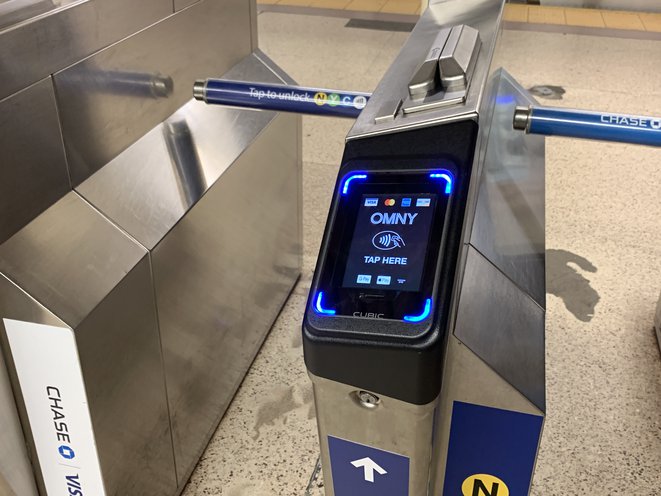
An OMNY reader on a turnstile. Tap your card or phone on the screen. Photo: MagicL55 · CC BY-SA 4.0 
An OMNY vending machine in a station mezzanine. Photo: Tdorante10 · CC BY-SA 4.0
Buying a ticket or card
You do not have to buy anything if you have a contactless card or a phone. If you want a card just for the subway, OMNY vending machines sell a reloadable OMNY card and also single-ride tickets. They are in hundreds of subway stations across all five boroughs and take cash, bank cards or a phone. Check the MTA site for where they are and what a card or a single ride costs.
Subway manners
Stand to one side and let people get off before you board. When the train is crowded, take your backpack off and hold it at your feet, and do not spread your legs across two seats. On escalators and moving walkways, stand on the right and walk on the left. Keep your phone's speaker off and your bag off the seat next to you.
From the airport to the city
JFK has no direct subway. Take the AirTrain to Jamaica or Howard Beach and change there. The Long Island Rail Road from Jamaica is faster and costs more. LaGuardia has no rail, so take a bus to a subway stop. Newark has an AirTrain to NJ Transit and Amtrak. Each airport link has its own fare on top of the subway.
Common mistakes for first-time riders
Read the signs at the top of the platform stairs. Uptown and Downtown are often on opposite sides, and a wrong guess costs you a detour. Express trains skip stops, and two services on one track will not stop at the same stations. Weekend and night service often differs from the weekday timetable, so read the notices on the platform.
New York in photos
Photos of New York and of places you pass on its lines. Every photo is credited to its photographer under its open licence.
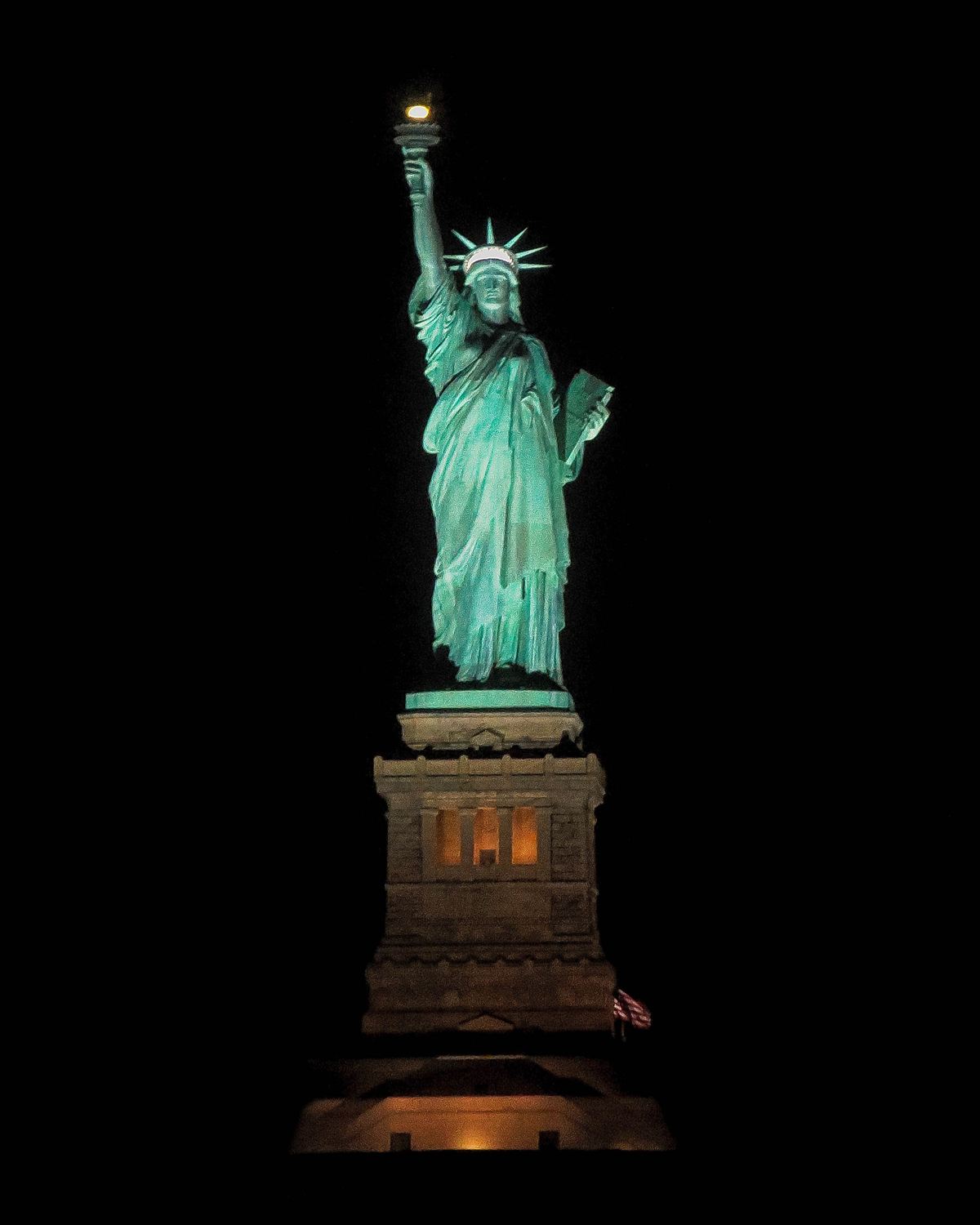
Photo: William Haslet · CC BY-SA 4.0 
Photo: Mike Sinko · CC BY 2.0 
Photo: David Shankbone · CC BY-SA 3.0 
Photo: Carlos Delgado · CC BY-SA 3.0 
Grand Central Terminal at Grand Central-42nd Street. Grand Central Terminal is a Beaux-Arts landmark completed in 1913, and the subway station sits directly beneath its famous Main Concourse. The vaulted ceiling above the concourse is painted with a mural of the constellations and lit by enormous arched windows. Beyond serving commuter trains, the terminal is a dining and shopping destination in its own right, home to the century-old Oyster Bar.Photo: D. Benjamin Miller · CC0 1.0 
New Amsterdam Theatre at Times Square-42nd Street. The New Amsterdam Theatre on West 42nd Street opened in 1903 as one of Broadway's earliest Art Nouveau playhouses and was long the home of the Ziegfeld Follies. After decades of decline, it was restored by the Walt Disney Company in the 1990s as part of the revitalization of 42nd Street, reopening with lavishly restored murals and ornamentation. Its vertical marquee, spelling out 'AMSTERDAM' in lights, now announces Disney's long-running Broadway musicals to the Times Square crowds below. The theater's elaborate terra-cotta facade remains a centerpiece of the reborn 42nd Street theater block.Photo: Ajay Suresh · CC BY 2.0 
Vessel at 34th Street-Hudson Yards. Designed by Thomas Heatherwick and opened in 2019, this 150-foot honeycomb-like structure of interlocking staircases sits at the center of Hudson Yards Public Square. It consists of 154 flights of stairs, 2,500 steps, and 80 landings, and after a period of safety-related closures it reopened to the public in October 2024 with floor-to-ceiling steel mesh installed around its landings. It has become one of the most photographed structures built in New York City in recent years.Photo: Antony-22 · CC BY-SA 4.0 
Gantry Plaza State Park at Vernon Boulevard-Jackson Avenue. Gantry Plaza State Park is a waterfront park along the East River in Long Island City, built on a former industrial rail-barge site. Its best-known feature is a pair of preserved black transfer gantries that once loaded rail cars onto barges, now standing as a photogenic landmark with the Manhattan skyline as backdrop. The park also offers piers, lawns, and a small dog run along the river.Photo: Tdorante10 · CC BY-SA 4.0 
MoMA PS1 at Court Square. MoMA PS1 is a contemporary art museum housed in a converted 1893 public school building, now affiliated with the Museum of Modern Art in Manhattan. It is known for large-scale installations, experimental exhibitions, and the summer Warm Up outdoor music series held in its courtyard. The building itself, with its red-brick facade and industrial-schoolhouse feel, is a Long Island City landmark in its own right.Photo: Sashimi-b · CC BY-SA 4.0 
Unisphere at Mets-Willets Point. This 12-story stainless-steel globe was built as the centerpiece of the 1964-65 World's Fair, celebrating the dawn of the Space Age with three rings representing the paths of the first satellites. It stands directly across from Citi Field in Flushing Meadows-Corona Park and is ringed by a fountain, becoming one of the most photographed structures to survive from either of the two World's Fairs held on this site.Photo: Ajay Suresh · CC BY 2.0 
New York City Hall at City Hall. Completed in 1812, New York City Hall is the oldest city hall in the United States still used for its original government function, housing the offices of the mayor and the City Council chambers. Its French Renaissance and Federal-style facade overlooks City Hall Park directly above the City Hall station.Photo: Aude · CC BY-SA 2.5 
New York Public Library Main Branch at 5th Avenue. The Stephen A. Schwarzman Building is the flagship location of the New York Public Library, a Beaux-Arts landmark completed in 1911 at Fifth Avenue and 42nd Street. It is instantly recognizable by the two marble lion statues, nicknamed Patience and Fortitude, flanking its grand entrance steps. The building sits directly across from Bryant Park, making this stretch of Fifth Avenue one of the most visited corners of Midtown Manhattan.Photo: Geraldshields11 · CC BY-SA 4.0
Stories about New York
 HistoryWhy the New York subway has numbers, letters and three historiesThe map looks like one system because it has been one system since 1940. Before that it was three companies that did not much want to cooperate.
 TypingA ten-minute practice routine that uses the subwayA plan for getting faster without getting sloppy, built around short rides rather than long drills.
 Photo rideThe 7 train, from Flushing to Hudson YardsTwenty-two stations across Queens and under Manhattan, past a World's Fair globe, a jazz house, a lemon ice stand and a very large staircase.
 TypingThe longest station names in the game, and why most of them are in New YorkOf the 1,800 or so stations you can type in HelloSubway, 33 need 30 keys or more. Twenty-four are in New York, nine are in Paris, and none are anywhere else.
 Photo rideWhere the lines meet: the biggest interchange stations in six citiesNew York has a station where nine of our lines call. The other five cities top out at three to six. Here are the hubs, and what they mean when you have to change trains.
 TypingThe words that fill station names: Street, Park, de and ShinIn New York, 220 of 433 station names contain the word Street. In Paris, 38 of 309 contain de. We counted the most common words in each of our six cities.
 Photo rideNew York's L train in sixteen photographs, from Chelsea to CanarsieTwenty-four stops from the High Line to Jamaica Bay, through Williamsburg and Bushwick, with a cemetery, a market, a church and the oldest house in the city.
 HistoryHow deep does the metro go? The deepest station in six cities, from 36 to 58 metresA trip down, city by city: Paris at 36.7 metres, Tokyo at 42, Singapore at 43, New York at 53, Seoul at about 55 and London at 58.5. Some of them you can type in the game, and one you can only see as a dotted line.
 Photo rideNew York subway tips: OMNY, express trains and art undergroundThe subway runs around the clock, the MetroCard is gone and your bank card is the ticket. How to tap in, why the train skips your stop, and the stations that are worth looking at.
 Photo rideNew York subway stations and what each one is known forFrom Grand Central and Times Square to Coney Island, Stonewall and the Unisphere. One stop, one sight, one detail you can check.
 Photo rideConey Island-Stillwell Avenue: the last stop on four subway linesAn eight-track elevated terminal, a Ferris wheel from 1920, a wooden coaster from 1927 and a hot dog stand from 1916, all within a few blocks of the end of the line.
Station exit guides
Which exit to take for the main sights, from the official tourism pages for each station.
Station names in New York
Many names here are long or carry a street number, such as 14 St or 59 St. The longer lines sit near the top of the difficulty scale for that reason.
All New York lines
- 1 Train38 stations · Lv 6/7 · ~609 keystrokes
A local service running the full IRT Broadway-Seventh Avenue Line, part of the original 1904 IRT subway, New York's first. It runs from South Ferry in Lower Manhattan up the West Side along Broadway to Van Cortlandt Park-242nd Street in the Bronx.
- 2 Train49 stations · Lv 7/7 · ~810 keystrokes
An express service starting at Wakefield-241st Street in the Bronx, running down the White Plains Road Line and the Lenox Avenue Line through Harlem, through the shared Broadway-Seventh Avenue express trunk with the 1 train (96th St-Chambers St), then out along the Eastern Parkway Line and Nostrand Avenue Line in Brooklyn to Flatbush Avenue-Brooklyn College.
- 3 Train34 stations · Lv 5/7 · ~549 keystrokes
An express service starting at New Lots Avenue in Brooklyn, running up the Eastern Parkway Line, through the shared Broadway-Seventh Avenue express trunk with the 1 and 2 trains (14th St-96th St), then out along the Lenox Avenue Line in Harlem to Harlem-148th Street.
- 4 Train28 stations · Lv 5/7 · ~493 keystrokes
An express service starting at Crown Heights-Utica Avenue in Brooklyn, running up the Lexington Avenue Line through Manhattan, then out along the IRT Jerome Avenue Line in the Bronx to Woodlawn.
- 5 Train36 stations · Lv 6/7 · ~650 keystrokes
An express service starting at Flatbush Avenue-Brooklyn College, running up the Lexington Avenue Line through Manhattan, then out along the IRT Dyre Avenue Line in the Bronx to Eastchester-Dyre Avenue. During rush hours some trips instead run via the White Plains Road Line toward Nereid Avenue.
- 6 Train38 stations · Lv 6/7 · ~615 keystrokes
A local service running from Pelham Bay Park in the Bronx down the IRT Pelham Line, then through Manhattan on the Lexington Avenue Line's local tracks to Brooklyn Bridge-City Hall.
- 7 Train22 stations · Lv 5/7 · ~445 keystrokes
A service running the full IRT Flushing Line from Flushing-Main Street in Queens, through Long Island City, under the East River, and into Manhattan to 34th Street-Hudson Yards.
- A Train36 stations · Lv 6/7 · ~619 keystrokes
The longest line in the NYC Subway system, running from 207th Street-Inwood in Upper Manhattan down the Eighth Avenue Line, across Brooklyn on the Fulton Street Line, and all the way out to the Rockaway peninsula, terminating at Far Rockaway-Mott Avenue.
- B Train27 stations · Lv 5/7 · ~485 keystrokes
A weekdays-only express service running from 145th Street in Harlem down Central Park West, express along 6th Avenue through Midtown, across the Manhattan Bridge, and out to Brighton Beach on Brooklyn's Brighton Line.
- C Train40 stations · Lv 6/7 · ~688 keystrokes
The all-stops local on the Eighth Avenue Line, running from 168th Street in Washington Heights down Eighth Avenue and Central Park West, then along Fulton Street in Brooklyn to Euclid Avenue in East New York. It stops at the stations that the A train, which shares its tracks, runs past.
- D Train36 stations · Lv 6/7 · ~616 keystrokes
A service running from Norwood-205th Street in the Bronx down the Concourse Line, joining the Central Park West express tracks at 145th Street, express along 6th Avenue through Midtown, across the Manhattan Bridge, and out to Coney Island on Brooklyn's West End Line.
- E Train20 stations · Lv 4/7 · ~426 keystrokes
A service running from Jamaica Center in Queens express along the Queens Boulevard Line through Forest Hills and Jackson Heights, into Manhattan via the 53rd Street tunnel, then down the 8th Avenue Line to the World Trade Center.
- F Train45 stations · Lv 7/7 · ~786 keystrokes
A service running from Jamaica-179th Street in Queens local along the Queens Boulevard Line, through the 53rd Street tunnel into Manhattan (shared with the E), down the 6th Avenue Line local, through the Rutgers Street tunnel (Delancey/Essex Streets, East Broadway) into Brooklyn, then along the Culver Line (shared with the G from Jay Street-MetroTech to Church Avenue) all the way to Coney Island-Stillwell Avenue.
- G Train21 stations · Lv 4/7 · ~371 keystrokes
The Brooklyn-Queens Crosstown Local, the only New York City Subway service that never enters Manhattan. It opened in 1933 as a shuttle between Queens Plaza and Nassau Avenue, was extended to connect with the Culver Line at Bergen Street through the 1930s, and today runs local the entire way from Court Square in Long Island City, Queens to Church Avenue in Kensington, Brooklyn.
- J Train30 stations · Lv 5/7 · ~492 keystrokes
A service running from Jamaica Center in Queens along the elevated BMT Jamaica Line through Woodhaven, Cypress Hills, and Bushwick, across the Williamsburg Bridge, then down the BMT Nassau Street Line on Manhattan's Lower East Side to Broad Street. Also known as the Nassau Street Local.
- L Train24 stations · Lv 4/7 · ~389 keystrokes
A service running from 8th Avenue in Manhattan along the BMT Canarsie Line (14th Street Line), under the East River into Williamsburg, Bushwick, and East New York in Brooklyn, terminating at Canarsie-Rockaway Parkway. No fork, a single 24/7 route.
- M Train36 stations · Lv 6/7 · ~675 keystrokes
A service running from Forest Hills-71st Avenue in Queens local along the Queens Boulevard Line, through the 63rd Street tunnel into Manhattan, down the 6th Avenue Line local, then across the Chrystie Street Connection and the Williamsburg Bridge on the BMT Jamaica Line (shared with the J) into Brooklyn, continuing on the elevated Myrtle Avenue Line to Middle Village-Metropolitan Avenue in Queens.
- N Train28 stations · Lv 5/7 · ~446 keystrokes
A service running from Astoria-Ditmars Boulevard in Queens along the BMT Astoria Line, through Queensboro Plaza (shared with the 7 train), through the 60th Street Tunnel into Manhattan on the BMT Broadway Line, across the Manhattan Bridge into Brooklyn on the Fourth Avenue Line, and out along the BMT Sea Beach Line to Coney Island-Stillwell Avenue. Opened in 1915 as the Sea Beach Express, it took on its current "N" designation in 1961.
- Q Train29 stations · Lv 5/7 · ~460 keystrokes
A service running from 96th Street on the Second Avenue Subway (Upper East Side, opened 2017) through the 63rd Street Tunnel, express along the BMT Broadway Line through Midtown, across the Manhattan Bridge, and down Brooklyn's Brighton Line as a local (stopping at every station, unlike the B train's express) to Coney Island-Stillwell Avenue.
- R Train45 stations · Lv 7/7 · ~728 keystrokes
A service running from Forest Hills-71st Avenue in Queens along the Queens Boulevard Line local tracks (shared with the M), through the 60th Street Tunnel into Manhattan on the BMT Broadway Line local tracks, across the Montague Street Tunnel into Brooklyn, and down the Fourth Avenue Line local tracks to Bay Ridge-95th Street. In service since 1920, it is the only line to stop at every station on both the Broadway and Fourth Avenue Lines.
- W Train23 stations · Lv 4/7 · ~381 keystrokes
The weekday local on the Astoria and Broadway Lines, running from Astoria-Ditmars Boulevard in Queens through the 60th Street tunnel and down Broadway in Manhattan to Whitehall Street-South Ferry, stopping at every station. It runs only on weekdays.
- Z Train21 stations · Lv 4/7 · ~354 keystrokes
The rush-hour skip-stop partner of the J, running the same line from Jamaica Center in Queens over the elevated Jamaica Line and the Williamsburg Bridge to Broad Street in Lower Manhattan. On the Jamaica Line it skips a different set of stations than the J and stops at only 21 of them. It runs in the peak direction during rush hours only.